MALCOLM X, BLACK LIBERATION, AND THE ROAD TO SOCIALISM
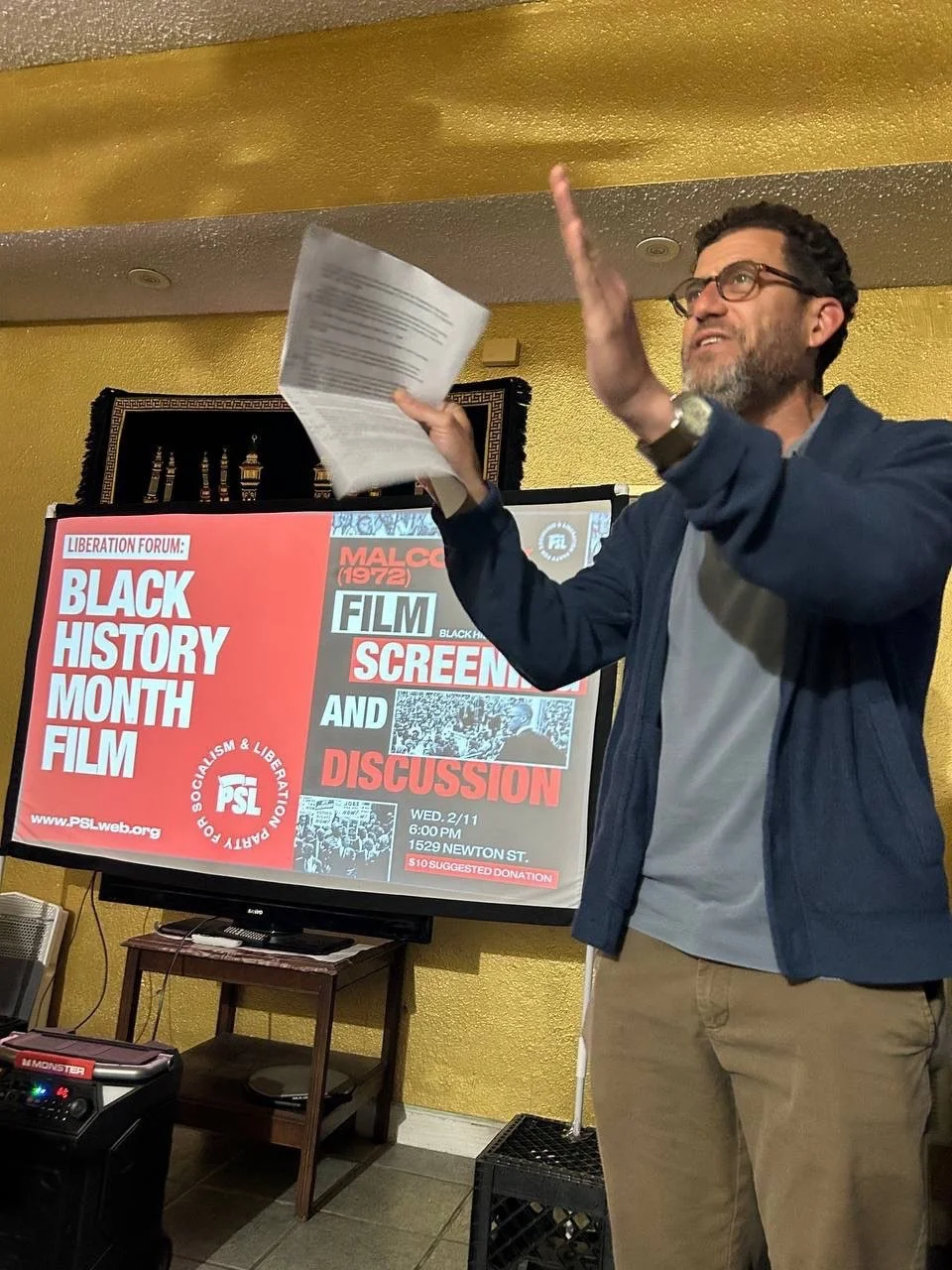
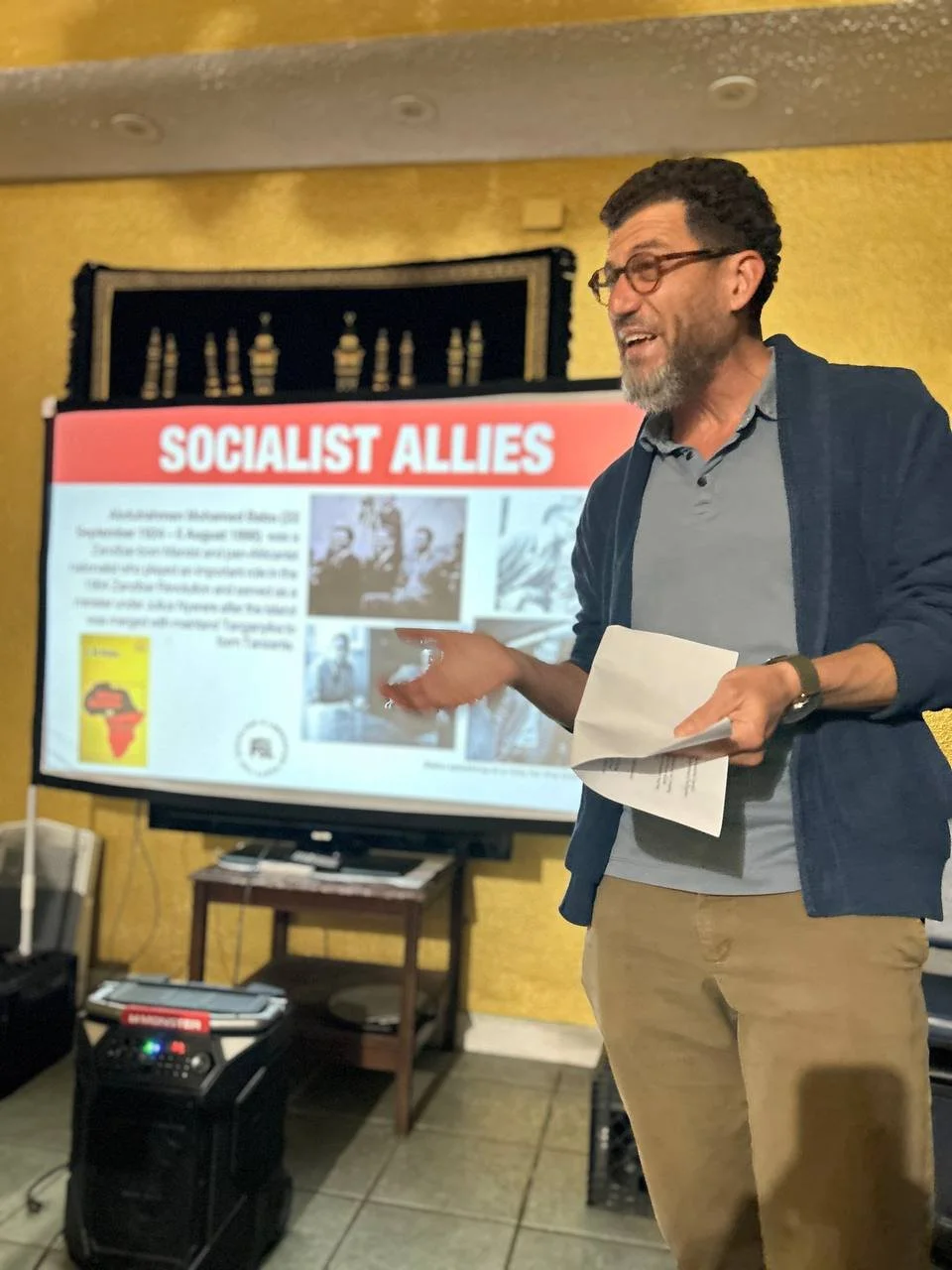
Last night I was honored to give a short talk on the last year of Malcolm X’s life at a PSL liberation forum. The talk was centered on the 1972 documentary of Malcom X for Black History month. The film is based on The Autobiography of Malcolm X, as told to Alex Haley. It’s a portrait of Malcolm’s story but not the totality thereof.
Malcolm’s life wasn’t a series of personal choices floating in the air; it was shaped by material conditions—by racism, exploitation, colonialism, and the violence of American capitalism. The Nation of Islam didn’t emerge out of theology alone. It emerged because Black people in the United States were living under conditions of national oppression. Segregation, police terror, economic exclusion—these realities created the ground from which the Nation of Islam grew. Malcolm didn’t simply believe in the Nation; he organized within it, spoke for Elijah Muhammad, and gave disciplined political expression to the anger and dignity of an oppressed people.
But history doesn’t stand still—and neither did Malcolm.
When he broke from the Nation of Islam, he didn’t retreat into individualism or liberal integrationism. He began to speak for himself, and more importantly, he began to speak to the world. The documentary hints at this, but an entirely different documentary could be filmed about the last year of his life. From March 1964 till his assassination on February 21, 1965 Malcolm made 2 trips to Europe, the Middle East and Africa. Malcolm encountered revolutionary movements fighting colonialism and capitalism head-on. He built relationships with Marxist revolutionaries, including Abduelrahman Mohamed Babu, and began to situate the Black struggle in the U.S. within a global context.
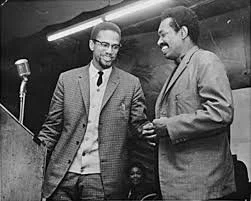
Malcom X and Abduelrahman Mohamed Babu
In this last year of his life Malcolm established the Muslim Mosque, Incorporated, and the Organization of Afro-American Unity (OAAU), a secular organization that sought to unite Africans and African-descended peoples across the Americas in a powerful political coalition. This is where Malcolm becomes unmistakably internationalist. He came to understand that racism in the United States was not an isolated moral failing—it was structurally tied to imperialism. The same system that super-exploits Black workers in the U.S. is the system that colonized Africa, occupies Palestine, and extracts wealth from the Global South.
Malcolm saw that working-class people across nations are not competitors, but allies locked in a common struggle against capital regardless of the color of their skin. His visit to Gaza in the September of 1964 and his meeting with the Palestinian Liberation Organization (PLO) profoundly sharpened this analysis. In an article published in The Egyptian Gazette in 1964, Malcolm wrote:
“The imperialists always make themselves look good, but it is only because they are competing against economically crippled newly independent countries whose economies are actually crippled by the Zionist-capitalist conspiracy. They can't stand against fair competition, thus they dread Gamal Abdul Nasser's call for African-Arab Unity under Socialism.”
—Malcolm X (Zionist Logic, The Egyptian Gazette, Sept. 17, 1964)
That is not the language of a liberal civil right activist. That is the language of anti-imperialist class struggle. So when viewing the film, we shouldn’t freeze Malcolm in time. When Malcolm X left the Nation he was evolving—toward socialism, toward internationalism, toward a revolutionary understanding that liberation requires not just representation, but the overthrow of systems built on exploitation.
The lesson for us is clear—oppression is not accidental, and it will not be reformed away. Racism, war, and poverty are tools of capitalism. If our struggles are global, then our solution must be global. If the problem is capitalism and imperialism, then the answer is organized, socialist resistance—rooted in the working class, disciplined, international, and unapologetically revolutionary.
Malcolm didn’t just ask us to see the world as it is. He challenged us to change it.
To understand where Malcolm was headed politically, it’s also important to place him in a longer revolutionary tradition in the United States. One key figure here is Harry Haywood, a leading Black communist and theorist in the Communist Party USA from the 1920s through the 1980s. Haywood developed what became known as the Black Belt thesis, which argued that Black people in the United States are not simply a racial minority, but an oppressed nation within a multinational state.
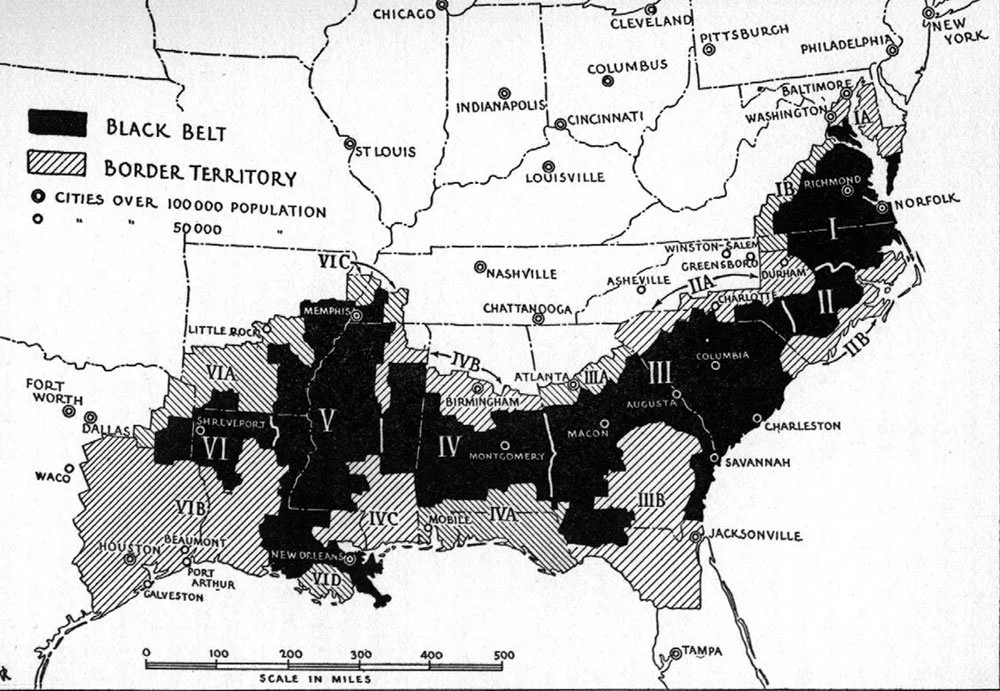
Drawing on Lenin’s theory of the national question and grounded in historical materialism, Haywood showed how slavery, Reconstruction, Jim Crow, and super-exploitation in the Deep South forged African Americans into a distinct people with a shared history, culture, and—crucially—a geographic base in the Black Belt South. In this sense, Black people were treated as an internal colony of U.S. capitalism, and therefore possessed the right to self-determination.
But Haywood was not a separatist. His entire framework was aimed at building a revolutionary, multinational working-class movement. He argued that genuine class unity was impossible unless white supremacy was fought relentlessly, and unless communists earned the trust of Black workers through concrete struggle. At the same time, he subjected both liberal integrationism and petty-bourgeois Black nationalism to class analysis, showing how neither could resolve the material conditions of Black oppression under capitalism.
Haywood insisted that Black liberation and working-class unity are not opposing goals—they are inseparable. White chauvinism among workers and narrow nationalism among the oppressed both serve the ruling class. The only way to break them down is through shared struggle, where Black workers lead and the multiracial working class fights together against capital.
This is the revolutionary tradition Malcolm was converging toward in his final years—an understanding that the fight against racism is a fight against imperialism, that national oppression is rooted in capitalism, and that liberation requires organization, internationalism, and socialism. The conclusion is unavoidable. Whether we look at Malcolm X’s evolution or Harry Haywood’s theory, the lesson is the same—there is no path to Black liberation, no path to Palestinian liberation, no path to human liberation that does not run through the overthrow of capitalism itself.
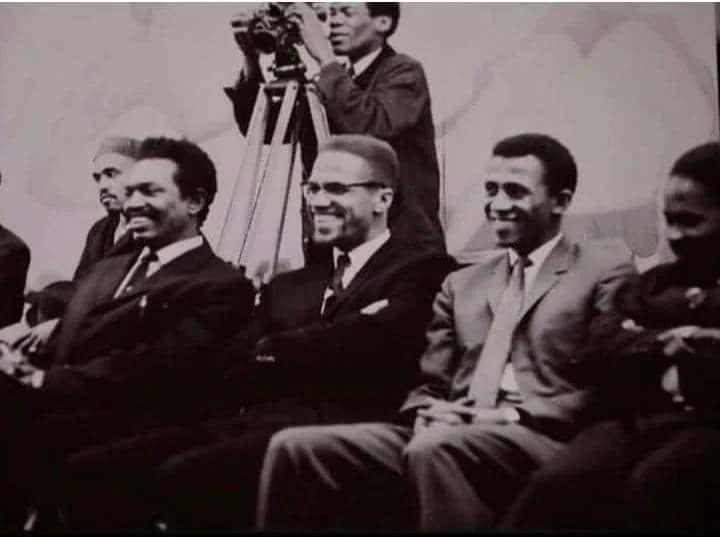
Abduelrahman Mohamed Babu and Malcom X
Our task is not to admire these figures from history, but to carry forward their unfinished work—building a disciplined, international, working-class movement capable of winning socialism. All of this leads to the real question before us—what does liberation actually look like once capitalism is overthrown?
The socialist conclusion is not chaos or bureaucracy, but a new form of democracy rooted in the working class and oppressed nations themselves. A socialist government would replace rule by billionaires and career politicians with genuinely representative institutions—one chamber, a National People’s Assembly, made up of delegates from local districts and mass organizations like labor unions, women’s and youth organizations, ensuring real working-class and multinational representation; and a second chamber, an Assembly of Oppressed Nations, designed to correct the historic crimes at the foundation of this country—settler colonialism, genocide against Native Americans, and the enslavement and super-exploitation of African Americans.
No law would pass without the consent of both the working class as a whole and the oppressed nations within the U.S., making equality not a slogan but a structural reality. Power would be decentralized into regional and local people’s assemblies for daily governance, while national decisions would be made collectively and applied universally—not to protect privilege, but to guarantee liberation.
This is the concrete answer to Malcolm’s question, to Haywood’s theory, and to the unfinished struggles we inherit—a revolutionary democracy that finally places political power in the hands of the multinational working class and opens the road to socialism.
—Eric Gabourel