Flex Posts Aren’t Enough: Rethinking St. Claude’s Bike Lane
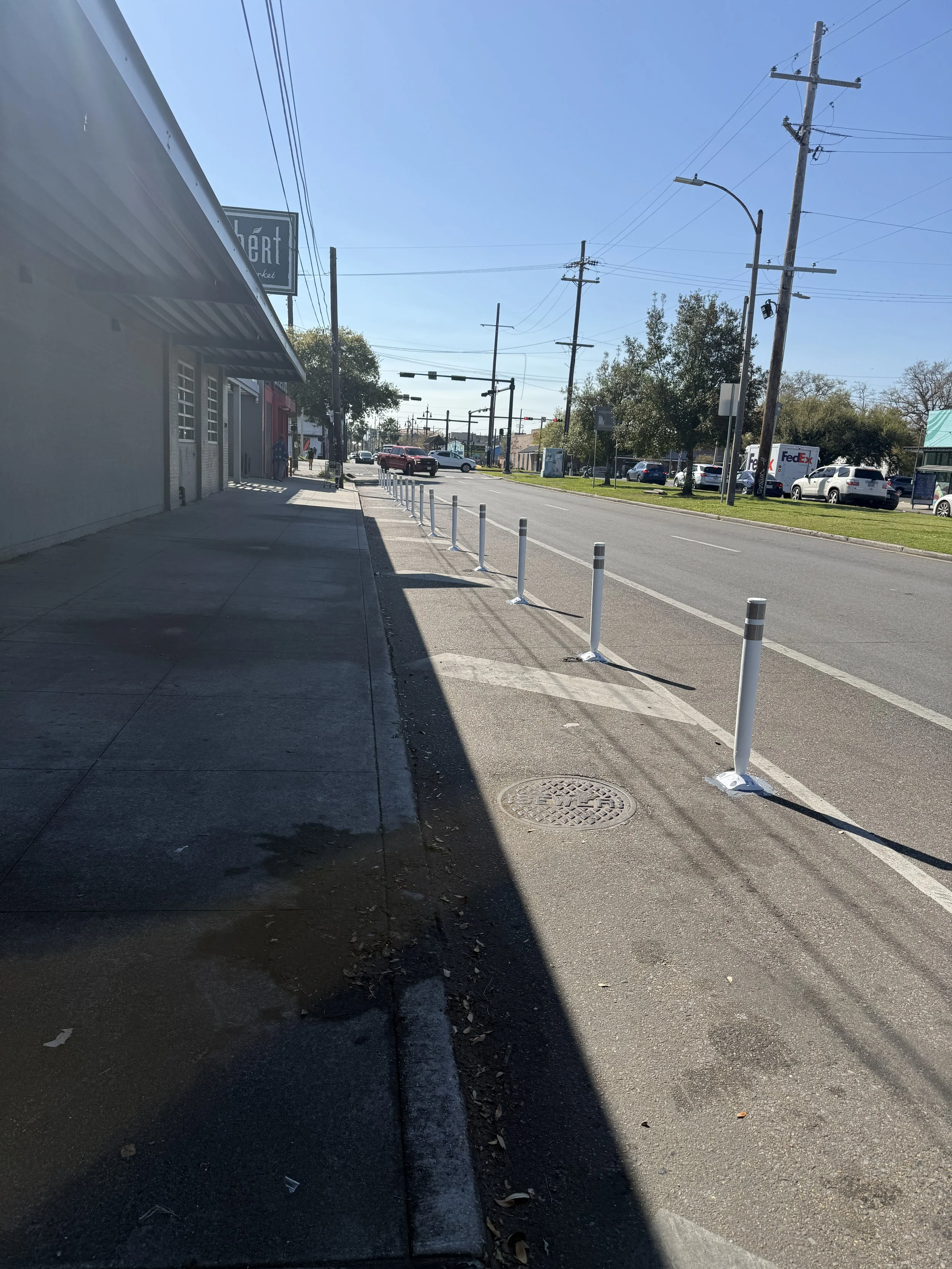
New flex posts have been installed along St. Claude Avenue between Elysian Fields Avenue and Marigny Street. While this intervention is a limited improvement—and may deter the routine occupation of the bike lane by private vehicles—it ultimately reflects the constrained logic through which our streets continue to be designed.
The current layout does not simply fall short of the long-standing demands of New Orleans bicyclists; it reveals a deeper prioritization of infrastructure that sustains the circulation of oil and its profits over collective safety. What appears as a minor design decision is, in fact, shaped by a broader economic reality. Our transportation system remains organized around the continuous consumption of fossil fuels, and the quarterly profits it produces for corporate giants and their investors.
A modest shift in the placement of these flex posts—moving them further into the existing bike lane—could have produced a truly separated facility. Such a change would have reallocated space toward safer, low-cost, and energy-efficient mobility. In the wake of two fatalities in these very bike lanes last year, the refusal to take even this minimal step reflects how even modest challenges to oil-dependent spatial design are routinely avoided.
This is not an issue of feasibility, but of political economy.
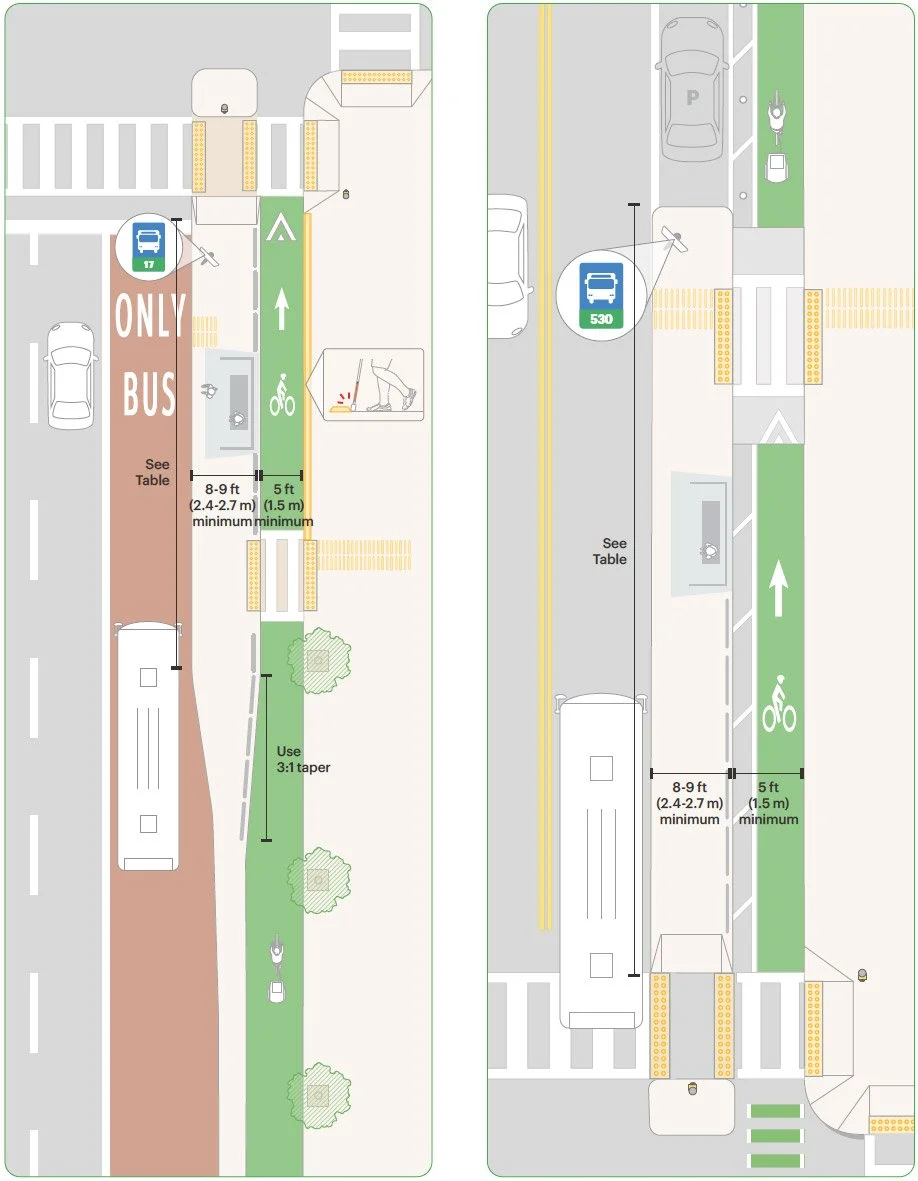
Best practices in street design clearly indicate that bicycle lanes should be placed adjacent to the sidewalk, with on-street parking repositioned outward to serve as a protective buffer. Along the approach to Marigny Street, parking could have been reorganized to create a continuous, protected bikeway across the entire block. That this was not implemented reflects a broader pattern: street space continues to be structured in ways that reproduce dependence on fossil fuels, rather than enabling viable alternatives.
The consequences are material. Cyclists, pedestrians, and transit riders—those least reliant on fossil fuel consumption—are exposed to disproportionate risk, while safer, lower-energy modes of transportation remain underdeveloped. The current design also appears to compromise ADA access to transit, further marginalizing those already excluded from full mobility. A bus boarding island, as outlined in the Urban Bikeway Design Guide (NACTO 3.5.1), would resolve this conflict—demonstrating that accessibility and safety are only treated as secondary concerns within a system oriented toward sustaining existing energy regimes.
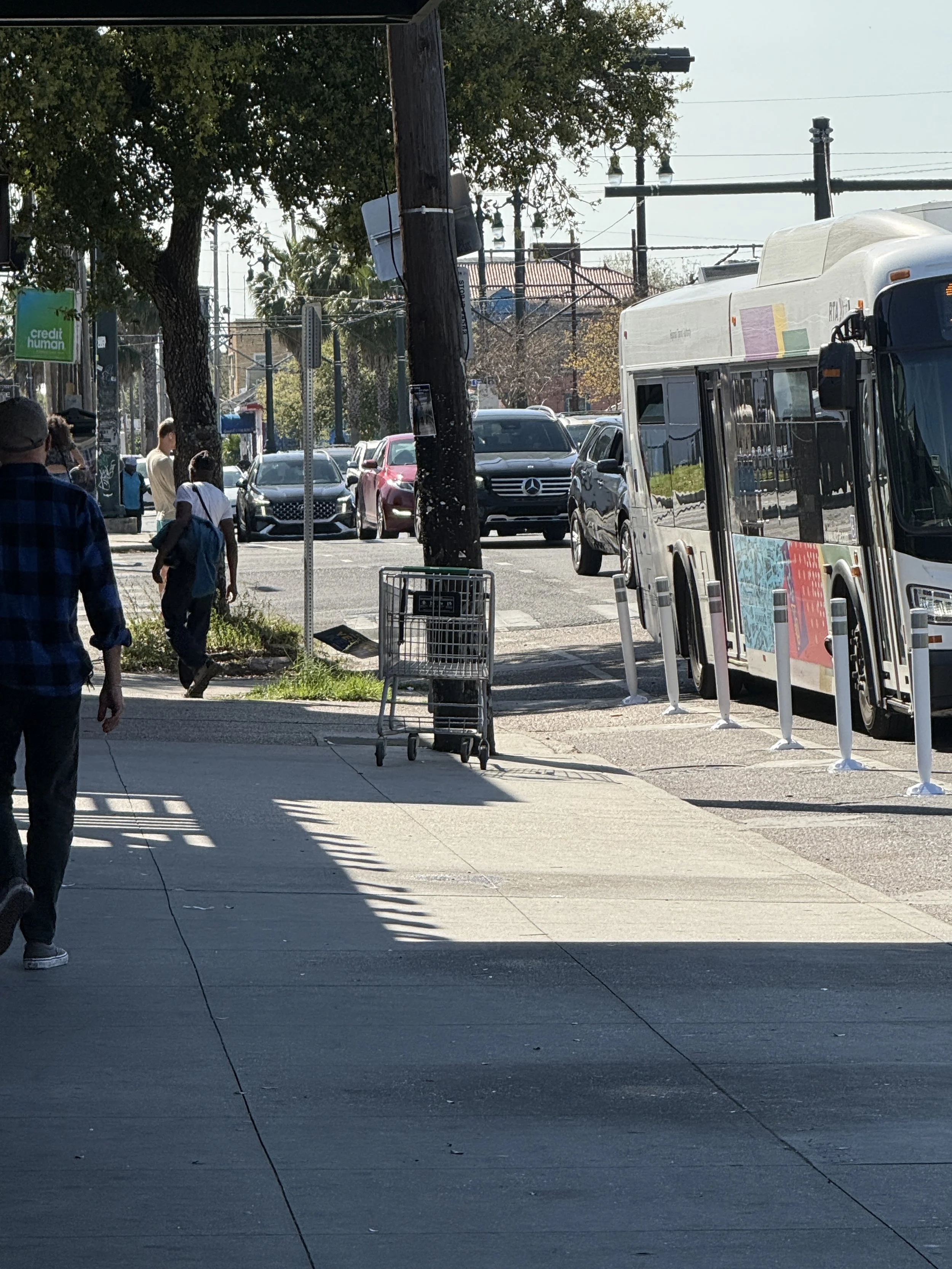
The Lack of ADA compliance the new flex post produce.
As the Louisiana Department of Transportation and Development considers the future of this corridor, it must reckon with the lives already lost on St. Claude Avenue. These deaths are not isolated—they are the predictable outcome of a system that privileges throughput, fuel consumption, and the steady realization of profit over human life.
St. Claude Avenue is not merely a state highway. It is a lived space—a corridor of work, culture, and community. To design it in a way that reinforces dependence on extractive industries is to subordinate that social life to distant economic interests.
What is required is not another incremental adjustment, but a reorientation of priorities: away from infrastructure that locks the city into oil dependence, and toward infrastructure that supports safe, accessible, and sustainable mobility for all. A protected, continuous bikeway is not just a design improvement—it is a small but meaningful step toward breaking that dependence, improving air quality, and protecting the environment.
As outlined in our petition, we urge the Louisiana Department of Transportation and Development (LADOTD) to act accordingly. St. Claude Avenue should be reimagined as a model for protected bicycle infrastructure—one that reflects the needs of the people who live there, rather than the demands of an extractive economy.
Join our Critical Mass Community bike ride on Friday, March 27th as we demonstrate our right to the road, and honor our fallen comrades that have fallen victim to an infrastructure that has been privatized for the oil and auto industries.
Another World is Possible!
-Eric Gabourel