The Federal Agenda to Remove Bike Lanes: Privatization, Profit, and the War for Automobile Dominance
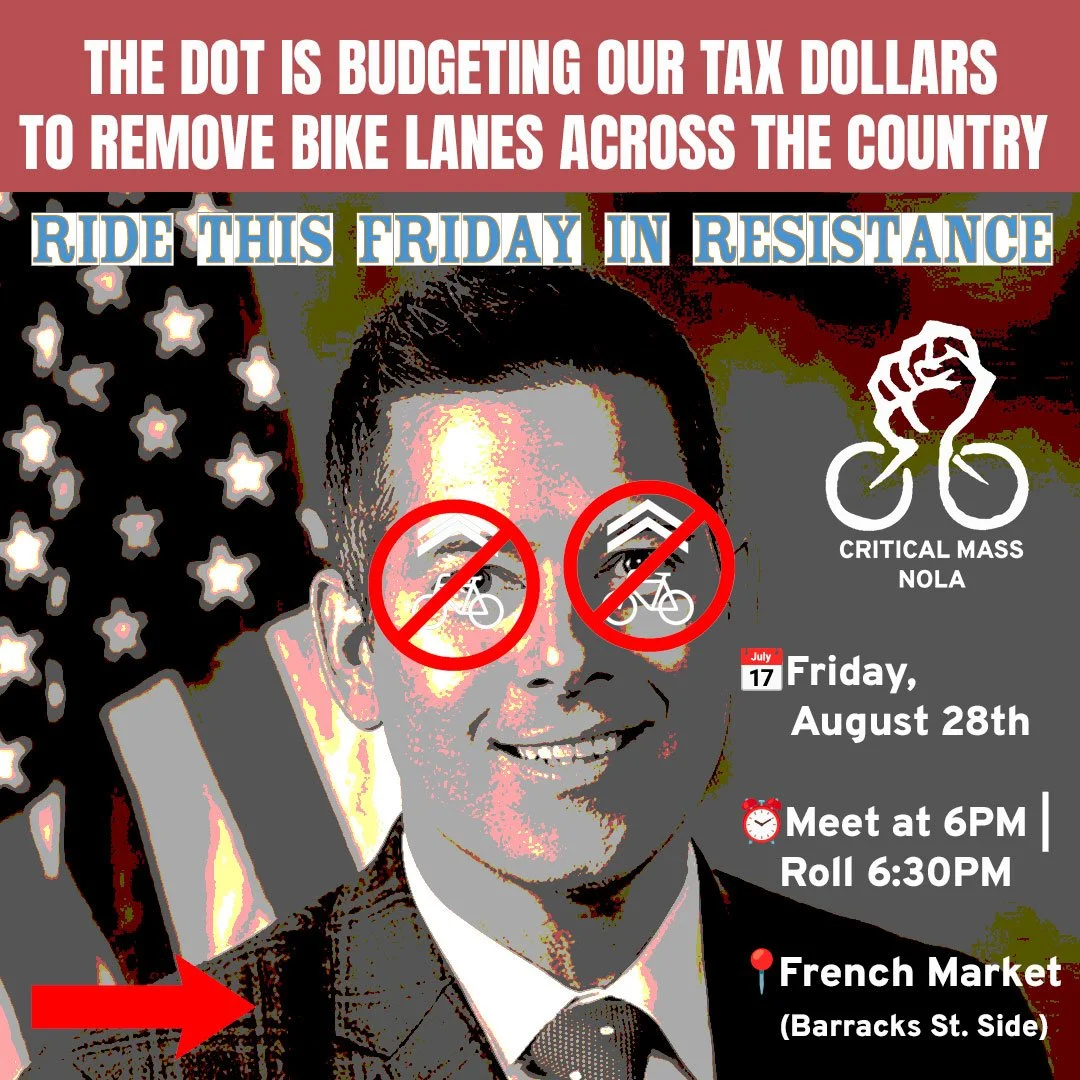
Federal Secretary of Transportation Sean Duffy not only wants to restrict funds for building bike lanes and complete streets, he wants to allocate funds to have bike lanes removed from our cities! Last month, he sent a letter outlining the administration’s priorities for the next Transportation Reauthorization bill to the Senate.
A Transportation Reauthorization bill is a major federal law that renews and sets the rules for how the United States funds and regulates transportation infrastructure for several years.
Instead of Duffy outlining a transportation plan that reduces carbon emissions, reliance on foreign oil, and Americans being exploited at the pump while oil corporations rake in record-breaking profits, he is advocating that the federal transportation system should prioritize using our tax dollars to physically remove bike lanes across the country to create complete reliance on the automobile for transportation. This is a clear declaration that our streets belong to the ruling class—a handful of billionaires who control the political apparatus and get to decide how our city streets are designed.
Duffy and the Trump administration want to tell us that the problem with American transportation is that we have spent too much money helping people walk and bicycle. They mock bike infrastructure as “DEI” spending, celebrate the automobile as the natural and unquestionable centerpiece of American life, and push Congress to restrict federal funding for public transportation, bicycle, and pedestrian infrastructure.
We reject this entire premise. For decades, private interests have built an enormous transportation system around the automobile—a transportation system that benefits the automobile and oil industries while our tax dollars pay for it. Simultaneously, we bear the consequences of private profit over public need with our lives.
Public money builds and maintains roads that enable the private sale of cars, trucks, gasoline, insurance, parking, and countless other commodities. The costs of building this infrastructure are socialized through our tax dollars, while private multi-billion-dollar corporations privatize and profit from them. After this vampiric system kills someone walking or riding a bicycle, we’re then told it was simply an “accident.”
But there is nothing accidental about building a transportation system in which the safest and most convenient way to move through a city is by automobile while everyone else is expected to gamble with their lives using the road in any other way.
Who Are Our Streets Built For?
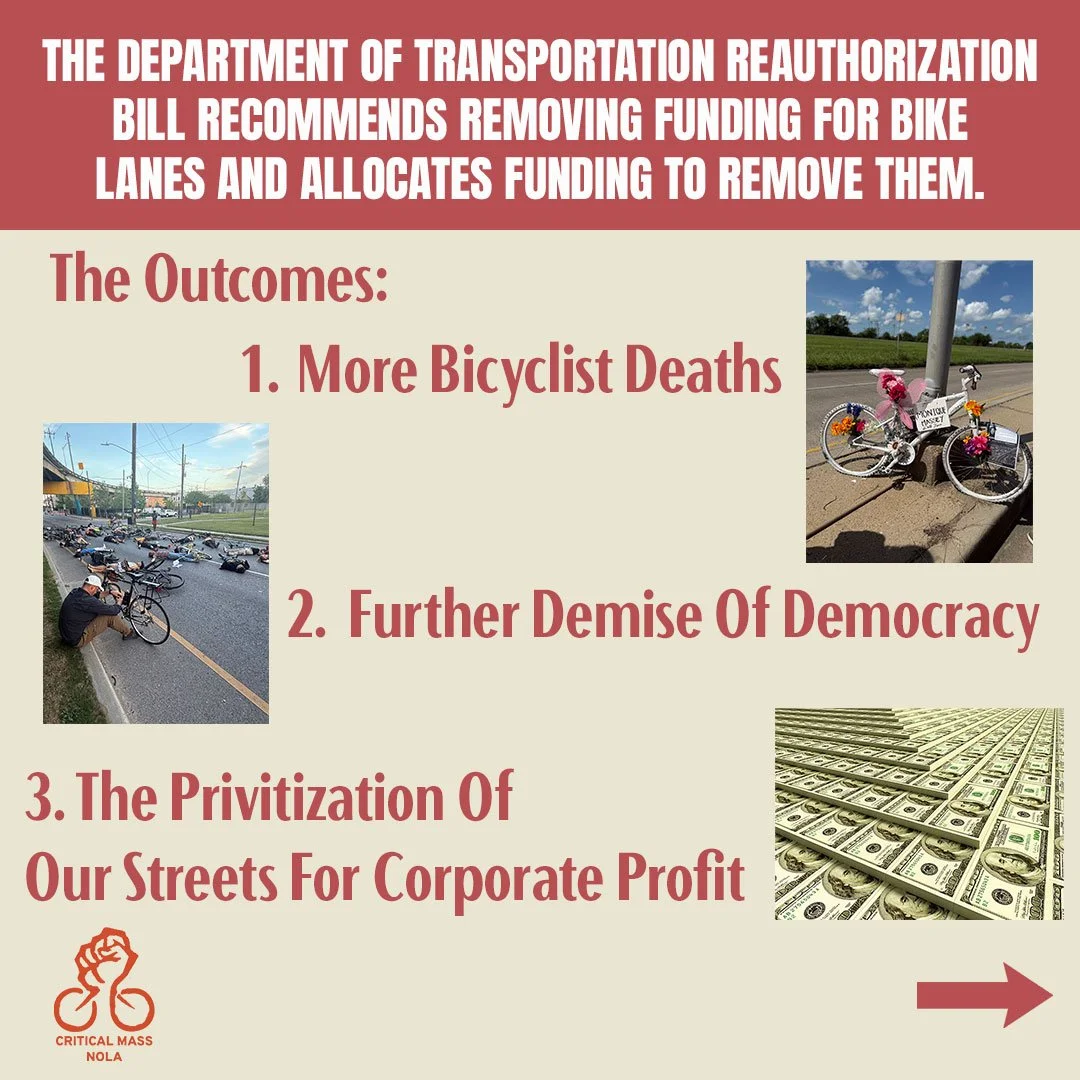
The automobile did not simply appear and take over American cities because people independently decided that cars were better. The landscape of American life was reorganized around the needs of automobile capital, from the creation of jaywalking laws to the National City Lines case.
In New Orleans, streets like Poydras were widened. Neighborhoods like the Treme were divided by highways. Our streetcars that once traversed the entire city disappeared. Parking consumed enormous amounts of urban land. Businesses and housing were pushed farther apart. Public transportation was neglected. Entire communities were displaced in the name of “progress.”
The result is a transportation system in which working people are frequently forced to purchase and maintain an automobile simply to participate in society. It’s no mistake that Louisiana has one of the highest rates of automobile debt in the country; the system is designed to create exploitation.
That is a clear form of oppression. Freedom and justice would mean that a person could walk, bicycle, take public transportation, or use an automobile without risking their life or being economically punished for choosing one mode over another. A democratic city is one in which its inhabitants don’t have to own a car.
A genuinely democratic transportation policy would begin with a simple principle: Transportation is a public necessity, not a commodity whose infrastructure should be designed primarily around private profit.
That is why Duffy’s attack on bike lanes matters. When the federal government says that bicycle infrastructure is wasteful while continuing to pour enormous resources into automobile infrastructure, it is not a neutral transportation decision. It is making a political choice about whose mobility matters and who’s allowed to utilize public infrastructure for private gain.
It’s clear that those interests serve the oil and automobile industries.
The Human Cost Comes to New Orleans
Here in New Orleans, we know exactly what happens when the automobile is given priority over human beings. Bike around our city and you will encounter ghost bikes—white bicycles chained to street corners where people were killed while riding.
They’re memorials, but they’re also indictments. Each ghost bike represents a person who had somewhere to go. Someone who was commuting, running an errand, visiting a friend, getting home, or simply trying to move through their own city. While the ghost bike alerts the public that a bicyclist died at the spot, it’s also an act of protest. It beckons the passerby to ask why our streets are designed the way they’re designed.
Why was the person on the bicycle expected to share a dangerous street exclusively designed for vehicles weighing thousands of pounds and that are allowed to travel at highway speeds? Why does moving automobiles quickly take precedence over protecting human life? Most importantly, who decided that this was an acceptable price to pay?
New Orleans has already lost too many bicyclists to traffic violence. Two bicyclists were killed on St. Claude Avenue last year and two on Claiborne Ave. this year. We have held memorial rides, installed ghost bikes, organized die-ins, and demanded protected infrastructure to commemorate their deaths.
Yet the fundamental problem remains. A painted line does not protect a human body from a speeding automobile. A sign does not stop an oversized truck from breaking the speed limit. A promise that drivers should “share the road” does not create safety when one participant weighs several thousand pounds and another weighs less than 200.
Physically separated bike lanes save lives because they physically separate people from traffic. This is basic infrastructure that all American cities should have.
The War on Bike Lanes Is a War on Public Space
Duffy’s agenda should therefore be understood as more than a dispute over transportation policy. It is part of a larger political struggle over public space. Who owns the street? Who determines how much space is devoted to cars? Who decides whether a lane becomes a parking lane, a traffic lane, a bus lane, or a protected bicycle lane? What’s considered when those decisions are made?
Under capitalism, the answer too often comes down to what generates the greatest return for private interests. The automobile industry needs roads. The oil industry needs gasoline consumption. The construction industry needs massive transportation projects. Developers benefit from highway expansion and automobile-oriented development. Corporations profit from the endless circulation of commodities through an infrastructure that the public finances.
We pay the bill for it, yet we don’t have a voice or a vote in how our infrastructure is planned. We pay for the roads with our labor and tax dollars. We pay for the automobile through monthly payments. We pay for gasoline, insurance, repairs, registration, parking, and maintenance. We pay through lost time sitting in traffic. And some of us pay with our lives.
This is why the fight for bicycle infrastructure should not be reduced to a lifestyle preference for people who happen to enjoy cycling. It’s a class issue. A person riding a bicycle should not have to prove that they deserve to exist on the street.
We Have to Organize
Congress needs to hear from us. The Transportation Reauthorization bill gives Congress enormous power to determine what federal transportation dollars can and cannot be used for. We should demand that Congress protect funding for walking, bicycling, public transportation, and safe streets—and reject any attempt to use federal money to tear out infrastructure that protects vulnerable road users.
But we cannot wait for Congress to save us. We, the people who use our streets every day, have to organize ourselves. It means demanding protected bike lanes from the City and the Louisiana Department of Transportation and Development. It means confronting transportation officials when they propose infrastructure that puts human lives behind automobile throughput. And it means taking the streets ourselves.
Take Back the Streets
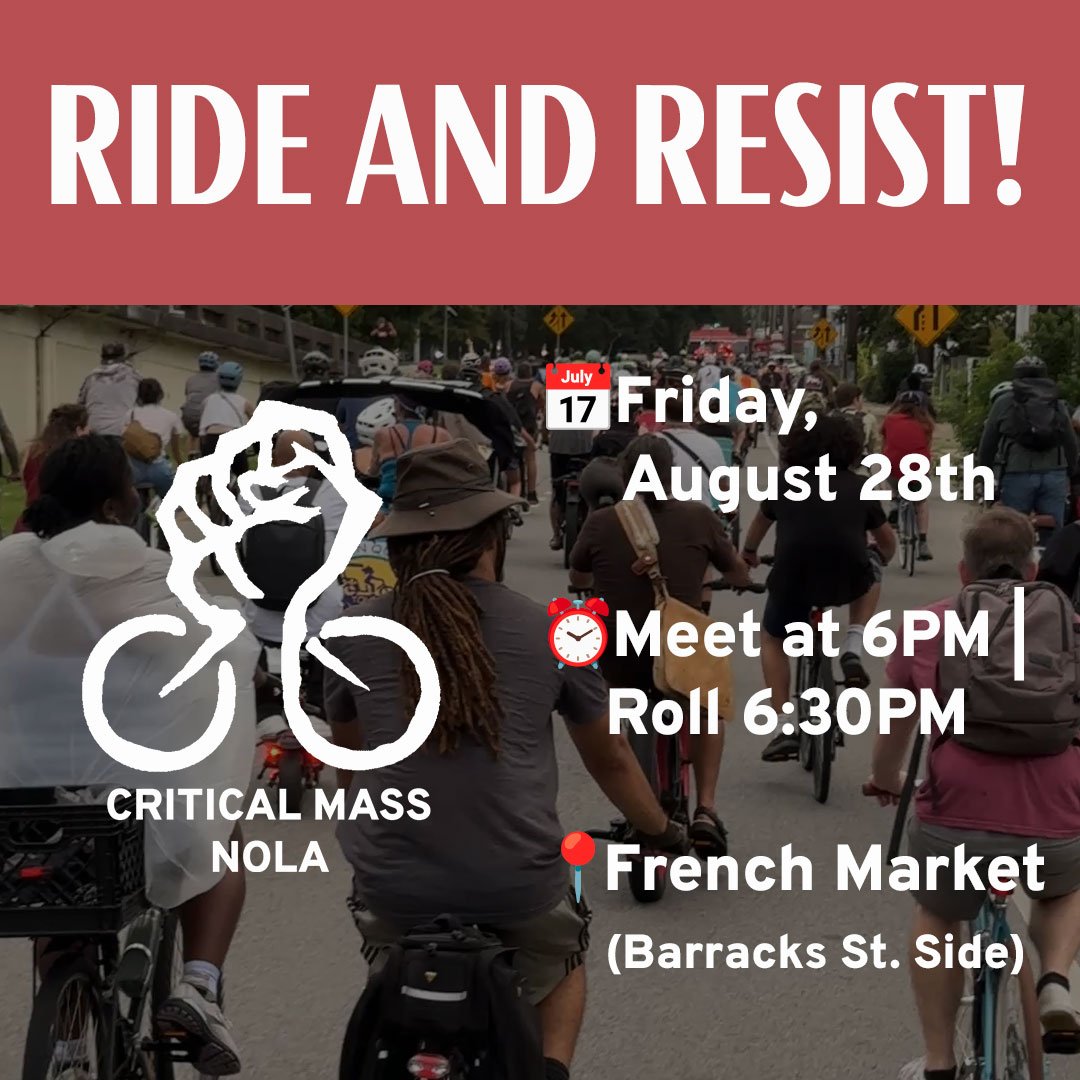
One of the ways we demonstrate our rights to the road and demand separated bike lanes is by taking over the streets in a mass community bicycle ride every last Friday of the month. This demonstration of collective protest is more than a bicycle ride. It is a collective demonstration of something that should be obvious but has somehow become radical: The streets belong to all of us.
When dozens or hundreds of people ride together, we make visible the people who are normally treated as an afterthought in transportation planning. We occupy public space collectively. We remind motorists, politicians, transportation officials, and one another that bicycles are not obstacles to traffic. We are traffic.
Our streets should not exist primarily to move commodities and private automobiles as quickly as possible. They should exist to move people.
And if Duffy and the federal government want to dismantle the infrastructure that protects us, then we need to make our voices and presence on the road impossible to ignore. Call Congress to demand protected bike lanes and reliable public transportation. Then join Critical Mass Nola this month to demand streets designed around human beings rather than private profit. Let’s state loud and clear that the most effective street is not the street where cars can drive the fastest. It’s the street where everyone has equal access and gets home alive.
Vive la Vélorution
—Eric Gabourel