The Entergy Show: Mack the Knife and the Theater of Corporate Power
One of New Orleans' native sons, Louis Armstrong, introduced me to one of my favorite playwrights. Among Satchmo's vast repertoire, "Mack the Knife" has always stood out. The song somehow reminded me of one of the so many characters one encounters growing up in New Orleans. I was curious about just what New Orleans personality the mysterious character Mack the Knife was based on. What I discovered was that Macheath wasn't based on a sailor hanging out on Gallatin Street in the old French Market as I thought. Rather, the song originated as the opening number of Bertolt Brecht's The Threepenny Opera. Louis Armstrong introduced me not only to a timeless song, but to one of the twentieth century's sharpest critics of capitalism.
Brecht was a Marxist playwright who believed theater should do more than entertain. It should expose the hidden workings of society. In The Threepenny Opera, he challenges audiences to question the distinction between respectable business and organized crime. The play's central figure, Macheath—better known as Mack the Knife—is not portrayed as a wild outlaw lurking in dark alleyways. He is polished, charming, and entrepreneurial. His business simply happens to be robbery.
Throughout the play, Mack evades justice not because he is exceptionally clever, but because wealth and influence shield him from accountability. Police officials can be bribed. Politicians can be persuaded. Institutions that claim to uphold justice protect those who profit from exploitation. Brecht's satire reaches its climax in one of the most famous lines in modern political theater:
"What is the robbing of a bank compared to the founding of a bank?"
The point isn't that robbery is admirable. It's that respectability can become a costume, allowing powerful institutions to extract wealth on a scale no street criminal ever could while presenting themselves as indispensable pillars of society.
Nearly a century after The Threepenny Opera premiered, Brecht's critique still resonates. We continue to witness private institutions that wrap themselves in the language of public service while extracting wealth from ratepayers. Corporations spend millions cultivating an image of civic responsibility, sponsoring charitable events, funding your favorite nonprofit organizations, and branding themselves as trusted community partners. Behind the curtain, however, the incentives often remain the same: maximize returns for investors, protect political influence, and socialize costs.
No corporation embodies this contradiction in Louisiana more clearly than Entergy.
For decades, Entergy has presented itself as an indispensable public servant—a company keeping the lights on through hurricanes, rebuilding communities after disasters, and investing in Louisiana's future. Its advertisements celebrate resilience. Its executives speak the language of partnership. Its philanthropic contributions have reached many organizations that perform genuinely valuable work throughout our state.
Yet appearances can be deceiving.
Like Mack the Knife, Entergy has mastered the art of respectability. It performs concern for the public while operating within a system that’s chief concern are quarterly profits rewarded to corporate officials and shareholders. Working people pay rising utility bills, endure recurring outages, and shoulder the costs of infrastructure investments, while investors receive guaranteed returns. We are told these sacrifices are necessary, that there's no alternative, and that every rate increase is simply the price of reliable service.
But Brecht teaches us to ask a different question—Who benefits?
If we examine Louisiana's energy system through that lens, a different story emerges—one in which monopoly power, political influence, environmental injustice, and corporate expansion are not isolated problems but different acts in the same production—and Entergy has even staged theater in the most literal sense.
The Performance Behind the Curtain
If Brecht had been asked to stage a modern American utility company, he could scarcely have written a better script than what unfolded in New Orleans in 2018.
That year, Entergy sought to win public approval in the New Orleans City Council chambers to construct a new natural gas-fired power plant in New Orleans East. The company insisted the project was essential to modernize the city's electric grid and ensure reliable service. At public hearings, dozens of apparent "community members" packed the council chambers wearing matching orange T-shirts and enthusiastically voiced their support for the project. To the casual observer, it appeared that ordinary New Orleanians had turned out in force because they believed the plant was in the public interest.
It was all a performance.
Subsequent investigations revealed that Entergy had hired The Hawthorn Group, a Virginia-based public affairs firm, to help generate what appeared to be grassroots support for the project. Hawthorn, in turn, subcontracted the Los Angeles company Crowds on Demand, which recruited and paid actors to attend the hearings and pose as concerned local residents. Their job was simple--create the illusion of public consensus.
This practice, commonly known as astroturfing, manufactures fake grassroots movements to influence public opinion and political decision-making. Instead of persuading the public through facts and democratic debate, corporations create the appearance of public support where little or none actually exists.
The scheme eventually unraveled. No one in the Entergy corporation got prison time, rather Entergy was fined a mere $5 million for its role in the deception. Pocket change for the multi-billion dollar corporation. The consequences for the company were minimal compared to what was at stake. In the end the actors exited the stage, the deception was exposed, and the final act proceeded without interruption—the New Orleans City Council still approved construction of the plant.
Today, the New Orleans Power Station stands at the foot of the Green Bridge on Paris Road, generating carbon-intensive electricity just as Entergy had intended from the beginning. Community organizations challenged the project in court, but the Louisiana Supreme Court ultimately allowed construction to proceed.
Brecht understood that theater is not simply about what happens on stage—it is about what the audience is encouraged to believe. The paid-actor scandal was remarkable not merely because Entergy hired performers. It was remarkable because it revealed how corporations attempt to manufacture democratic legitimacy. The goal was never simply to build a power plant. The goal was to convince the public that the people themselves had demanded it.
Once the curtain was pulled back, the audience saw the machinery behind the production. The tragedy is that the play continued anyway.
Paying More, Receiving Less
The astroturf scandal was not an isolated incident. It was simply the most visible example of a system that consistently asks the working class to bear the costs while corporations enjoy the benefits.
Over the last decade, utility bills have risen far faster than wages for many Louisiana households. Families already struggling with housing, healthcare, groceries, and insurance have watched electricity become an increasingly heavy burden on their monthly budgets.
These increases are often explained as unavoidable. Hurricanes damage infrastructure. Fuel prices fluctuate. New transmission lines and generating facilities require investment. All of these realities contain elements of truth. But they also raise a more fundamental question—who should bear those costs?
Under Louisiana's current utility model, the answer is you, the customer.
When fuel prices rise, Entergy can recover those costs through fuel adjustment charges that fluctuate from month to month, shifting the risks of volatile energy markets onto households. When storms damage the grid, the costs of rebuilding are also passed on to ratepayers. When billions of dollars are invested in new infrastructure, customers finance those investments through higher rates—even though the infrastructure remains privately owned and generates future returns for shareholders.
Under the regulated utility model, risks are socialized while the profits remain private. Working people pay to expand and modernize assets they do not own, cannot govern, and have little meaningful influence over.
Electricity is not a luxury. It powers traffic lights, street lights, refrigerators, medical equipment, schools, workplaces, and homes. It is an essential public necessity. Yet the capitalist system treats it as a commodity whose primary purpose is to generate wealth for investors.
Paying More Doesn't Mean Better Service
Despite repeated rate increases, widespread concerns about reliability persist. Entire communities endured prolonged blackouts following Hurricane Ida in 2021. Rolling outages have affected customers during periods of peak demand. Even outside of major disasters, neighborhoods across Louisiana regularly experience localized outages caused by aging equipment and distribution failures.
Not only is this experience deeply frustrating. Every year we're asked to pay more for electricity, yet we continue to wonder whether the lights will remain on after the next major storm. This contradiction lies at the heart of growing public dissatisfaction. A utility system should first be judged by whether it reliably serves the people who depend upon it. Instead, Louisianans are paying more while receiving less.
Whose Energy Future?
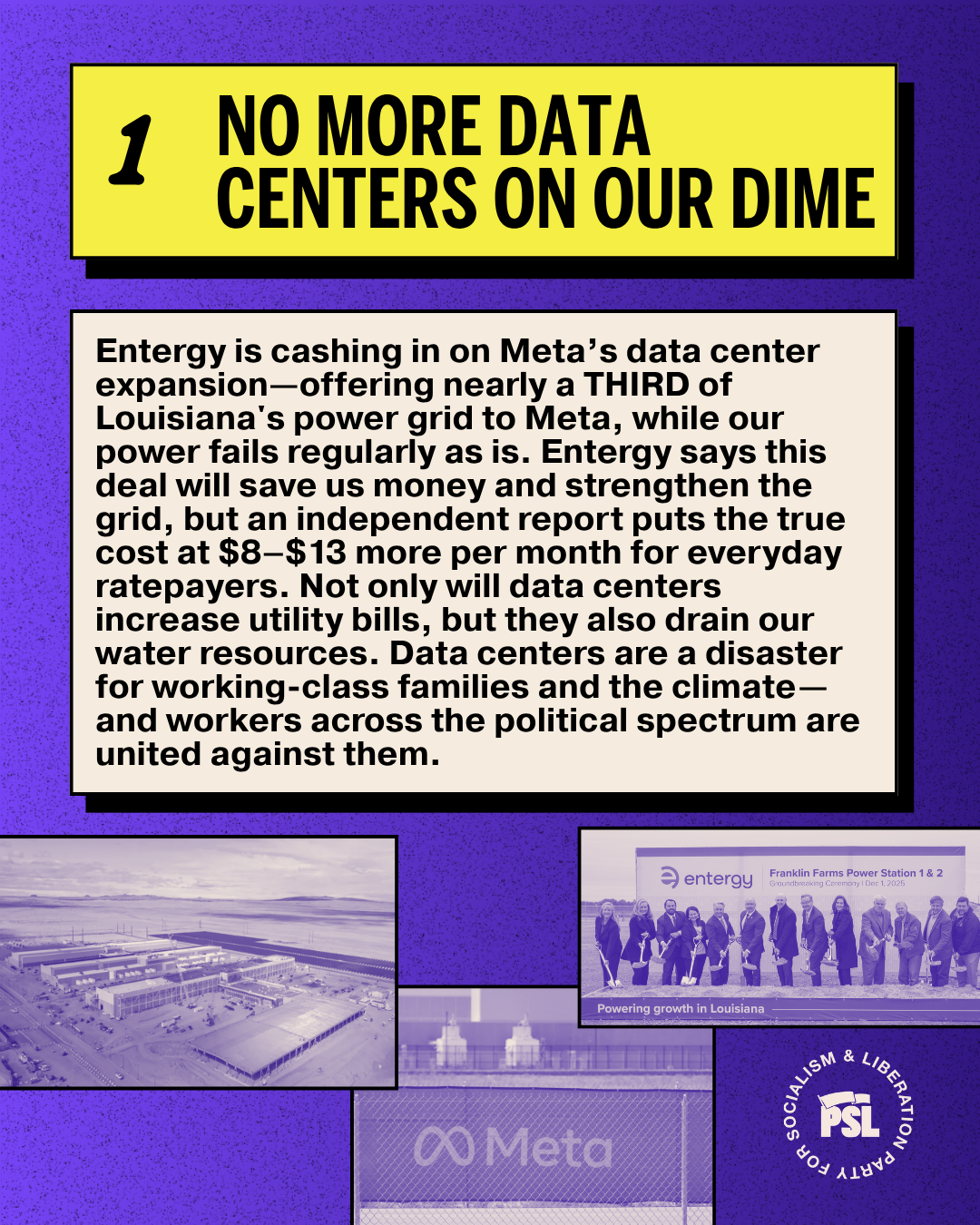
Nowhere is this contradiction more visible than Entergy's plans to expand natural gas generation to meet the enormous electricity demands of Meta's planned AI data center in Richland Parish.
Supporters of these projects argue that new natural gas plants are necessary to maintain reliability while attracting billions of dollars in private investment. Manufacturing facilities, data centers, and other large industrial customers require dependable electricity around the clock, and dispatchable natural gas generation can provide power when renewable resources are unavailable.
That argument deserves to be taken seriously. Reliable electricity is essential, and Louisiana needs good jobs. But another question deserves equal attention—reliable electricity for whom?
The debate is not simply about whether Louisiana should generate more electricity. It is about who that electricity is being produced to serve, who profits from its production, and who pays the costs.
To supply energy for Meta's massive data center expansion, Entergy is proposing to build additional natural gas infrastructure. This approach locks the state into decades of continued fossil fuel dependence, increases greenhouse gas emissions, and delays investment in renewable energy, battery storage, and distributed community energy systems. Communities already burdened by industrial pollution—many of them predominantly Black and working class—would once again shoulder disproportionate environmental risks. Entergy is now creating a “Digital Cancer Alley”.
At the same time, ordinary ratepayers will ultimately finance infrastructure designed primarily to benefit some of the world's largest corporations.
This reflects a broader political choice. Louisiana's energy resources are increasingly being organized around the demands of multinational corporations and energy-intensive data centers rather than around the everyday needs of working people. Instead of asking how our energy system can provide affordable electricity, resilient communities, cleaner air, and democratic accountability, policymakers too often begin with a different question—what infrastructure is necessary to maximize private investment?
That is not merely an engineering decision. It is a political one.
Environmental Decay Is Not an Accident
The controversy surrounding Entergy's New Orleans East gas plant was never simply about a single power station. Residents, environmental organizations, and neighborhood groups questioned whether the plant was necessary at all and whether the surrounding community would once again be asked to shoulder environmental burdens for the benefit of corporate interests.
Natural gas is often presented as a cleaner alternative to coal, but that comparison obscures the broader concerns raised by communities living near gas-fired power plants. These facilities still emit greenhouse gases and air pollutants, and they become part of a much larger industrial landscape that has shaped southeast Louisiana for generations.
Nowhere is this reality more apparent than in Cancer Alley along the Mississippi River corridor and throughout southeast Louisiana, where refineries, petrochemical facilities, export terminals, and other heavy industries have been concentrated for decades. Many predominantly Black and working-class communities already live alongside some of the nation's highest concentrations of industrial pollution. Each new facility may be evaluated individually, but residents experience their effects cumulatively. Every additional smokestack, pipeline, and industrial expansion adds to an existing environmental burden.
This is why environmental justice cannot be reduced to questions of emissions standards or permitting decisions alone. It is also a question of political and economic power.
Communities with the fewest economic resources are often expected to absorb the greatest environmental costs, while the financial benefits of industrial development flow elsewhere—to corporate executives, investors, and shareholders. Pollution is not simply an unfortunate byproduct of modern industry; it reflects decisions about whose neighborhoods are considered expendable and whose health is treated as a cost of doing business.
Environmental justice requires more than mitigating pollution after the fact. It requires changing who has the power to make these decisions in the first place. An energy system organized around democratic public ownership could evaluate projects according to public health, environmental sustainability, and community well-being instead of shareholder returns.
An Energy Transition for People, Not Profit
Louisiana possesses extraordinary potential to become a leader in renewable energy. Our state has abundant sunlight, growing opportunities for offshore wind, and the technical workforce capable of building a modern electrical grid. Yet our energy future continues to be shaped primarily around expanding natural gas generation.
Entergy's generation portfolio remains dominated by natural gas and nuclear power, while renewable energy represents a comparatively smaller share of its capacity. Although renewable investments have grown in recent years, many advocates argue that the pace of that transition has been far too slow.
A different path is possible.
Utility-scale solar, battery storage, offshore wind procurement, and modern transmission infrastructure could significantly reduce dependence on fossil fuels while improving long-term resilience. Community solar programs would allow those whose roofs are unsuitable for solar panels to benefit from shared renewable generation instead of restricting those benefits to households wealthy enough to install their own systems.
Likewise, distributed energy systems—including neighborhood microgrids, rooftop solar, and local battery storage—could make communities less dependent on a handful of massive centralized generating stations. Instead of one outage leaving hundreds of thousands of customers without electricity, localized systems can improve resilience during hurricanes and other emergencies.
Unfortunately, progress has often been slower than many residents expected. New Orleans' community solar program, for example, has faced repeated delays and implementation challenges despite years of planning and public discussion.
But the challenge is larger than technology alone.
Replacing fossil fuels with renewable energy does not automatically democratize the energy system if ownership remains concentrated in the hands of a few large corporations. Solar panels owned by monopoly utilities can reproduce many of the same political and economic relationships as natural gas plants. Ultimately, the question is not only what fuels generate our electricity, but who owns the infrastructure, who controls investment decisions, and who benefits from the wealth those investments create.
A truly just energy transition must therefore pursue two goals simultaneously: decarbonizing our electric grid and democratizing control over the institutions that produce and distribute electricity.
A Monopoly Without Democratic Control
Unlike other consumer goods, electricity is not something we can shop around for in New Orleans. Families cannot compare competing electric utilities the way they compare grocery store prices. For most Louisianans, there is one provider, one monthly bill, and virtually no alternative.
Supporters of the current regulatory system argue that electricity is a natural monopoly. Building multiple sets of power lines and duplicate transmission systems would be enormously expensive and inefficient. In that respect, they are correct. Modern electrical infrastructure functions most efficiently as a unified network.
The real question is not whether electricity should be a monopoly. The question is who should own and control that monopoly.
Today, investor-owned utilities such as Entergy operate under government regulation while earning returns for private shareholders. Customers have limited leverage over billing disputes, little meaningful influence over long-term planning, and few alternatives when rates increase. Meanwhile, regulators are tasked with balancing consumer protection against ensuring sufficient profits for private investments.
This arrangement reflects a contradiction at the heart of investor-owned utilities. Electricity is an essential public necessity, yet decisions about investment, pricing, and infrastructure are ultimately shaped by obligations to wealthy private investors.
If electricity is indispensable to modern life, then democratic society—not financial markets—should determine how it is produced, distributed, and priced. Rather than attempting to make monopoly capitalism more competitive, the challenge is to replace private ownership with democratic public ownership, where workers, ratepayers, engineers, and communities participate directly in governing the utility they collectively invest and depend upon.
Following the Money
Understanding Entergy's ownership helps explain why these questions matter.
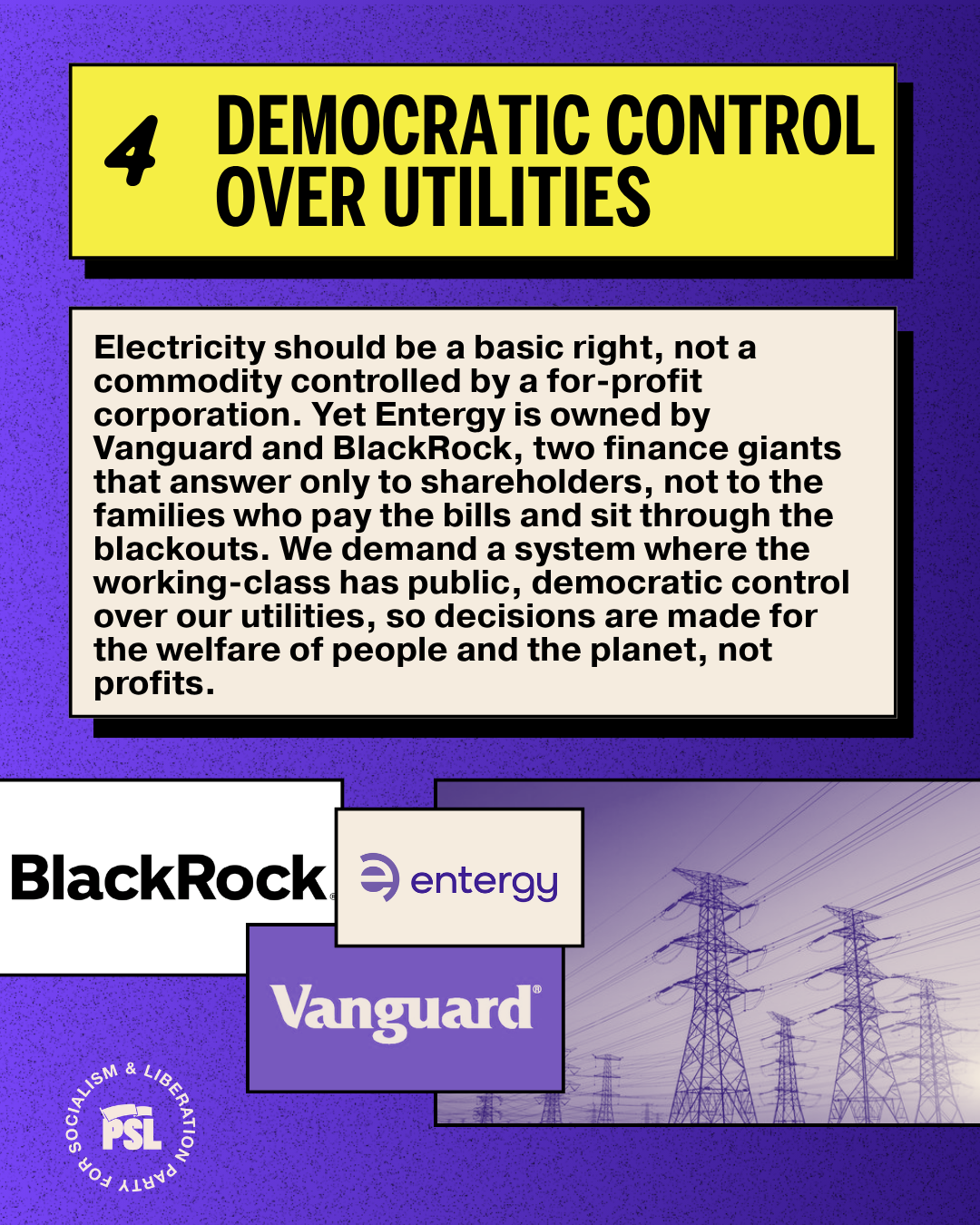
Among Entergy's largest shareholders are some of the world's largest financial institutions, including BlackRock, Vanguard, and State Street. These firms collectively manage trillions of dollars in assets on behalf of pension funds, retirement accounts, mutual funds, and exchange-traded funds. While they do not necessarily invest only their own money, they exercise substantial influence through the voting rights attached to the shares they manage.
Large institutional shareholders participate in board elections, vote on shareholder resolutions, and influence corporate governance. Their primary responsibility is to maximize returns for the investors whose assets they manage. That obligation shapes executive incentives, investment priorities, and long-term corporate strategy.
This does not mean that any single shareholder dictates every company decision. It does mean that the corporation operates within a system where financial performance for investors remains the central measure of success.
For working people in New Orleans, however, the priorities are different. Families want affordable bills, reliable electricity, resilient infrastructure, clean air, and democratic accountability. These goals do not align with maximizing shareholder value.
That tension lies at the heart of Louisiana's energy crisis. It is not simply a disagreement over utility regulation or individual projects. It is a conflict over who our energy system is designed to serve: financial markets or the people who depend on electricity every day.
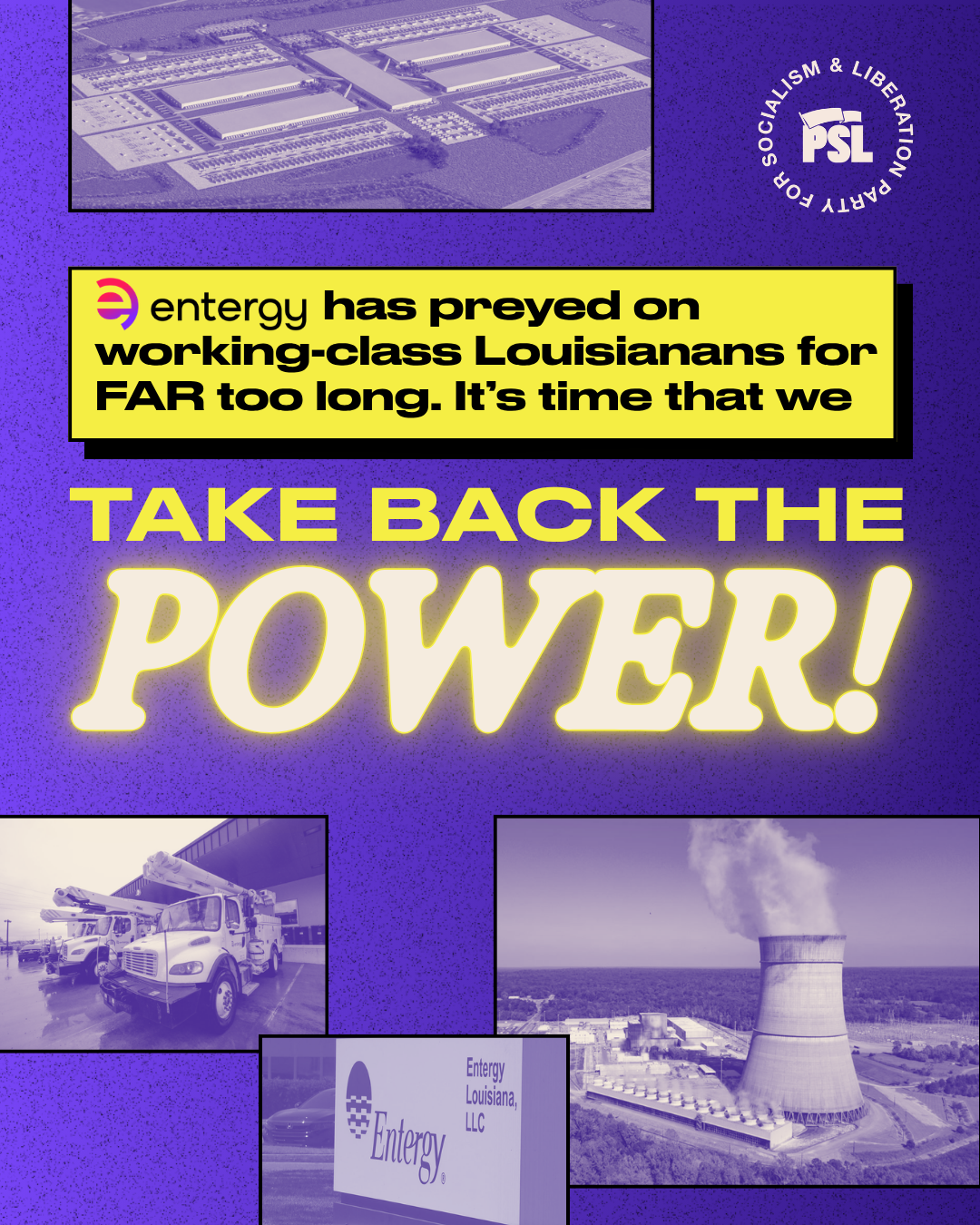
It’s Time To Take Back The Power!
Today, Louisiana stands at another crossroads. Meta's planned Hyper scale AI data center in Richland Parish represents one of the largest private investments in our state's history. Originally announced as a $10 billion project, it has expanded into a development expected to exceed $50 billion, spanning roughly 3,650 acres and requiring approximately five gigawatts of electrical capacity—enough electricity to rival the consumption of major cities.
To meet that demand, Entergy is pursuing an unprecedented expansion of generating capacity, including multiple new natural gas-fired power plants across Louisiana. Company officials argue these investments are necessary to support economic development and ensure reliable service. Meta has stated that it will finance much of the infrastructure required to serve its operations.
Yet important questions remain. Even if Meta contributes to the initial construction costs, the generating plants, transmission lines, and supporting infrastructure will continue operating long after the company's contractual commitments expire. It will be ordinary ratepayers who will bare a substantial share of the long-term costs of maintaining and replacing infrastructure built largely to support one of the world's wealthiest corporations.
This reflects an all too familiar pattern. As mentioned above, the costs of economic development are frequently socialized among working people, while the profits remain concentrated in private hands. The working class are forced to finance the conditions necessary for corporate expansion through higher rates and public infrastructure, even though they exercise little control over how those investments are made.
In light of this exploitation inflicted by both private corporations and the state, Critical Mass Nola support’s the Louisiana Party for Socialism and Liberation's Take Back the Power campaign.
Electricity is not a luxury. It is a basic necessity that powers our street infrastructure, homes, schools, hospitals, workplaces, and communities. Decisions about such an essential service should not be driven primarily by shareholder returns or the energy demands of multinational corporations. They should be guided by the needs of the people who depend upon the grid every day.
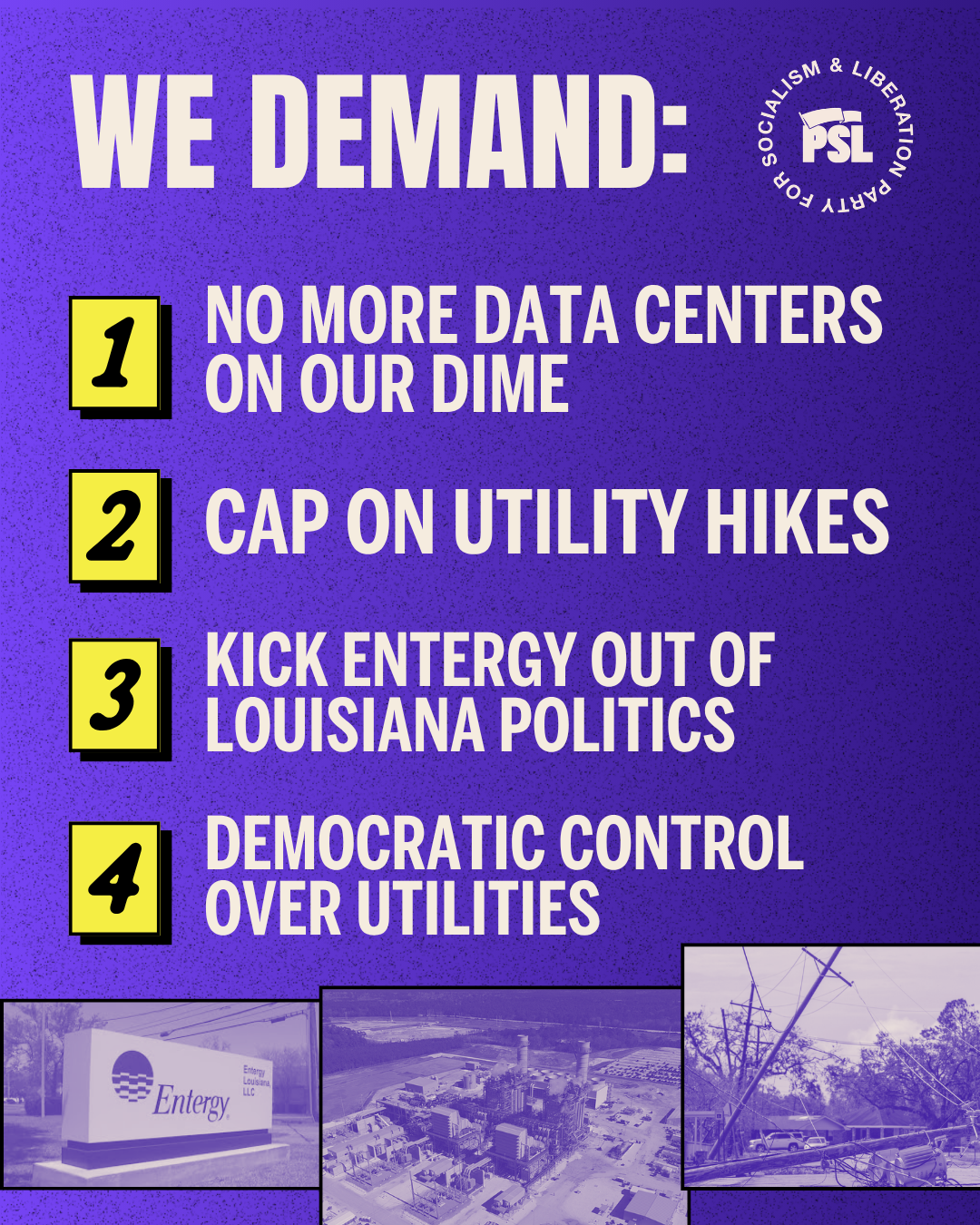
To build a utility system that serves working people instead of corporate profits, Louisiana PSL demands:
1. No More Data Centers On Our Dime
Entergy is dedicating nearly a third of Louisiana's power to Meta's data center while residents face higher bills and unreliable service. Working people shouldn't have to subsidize corporate profits.
2. A Cap on Utility Rate Hikes
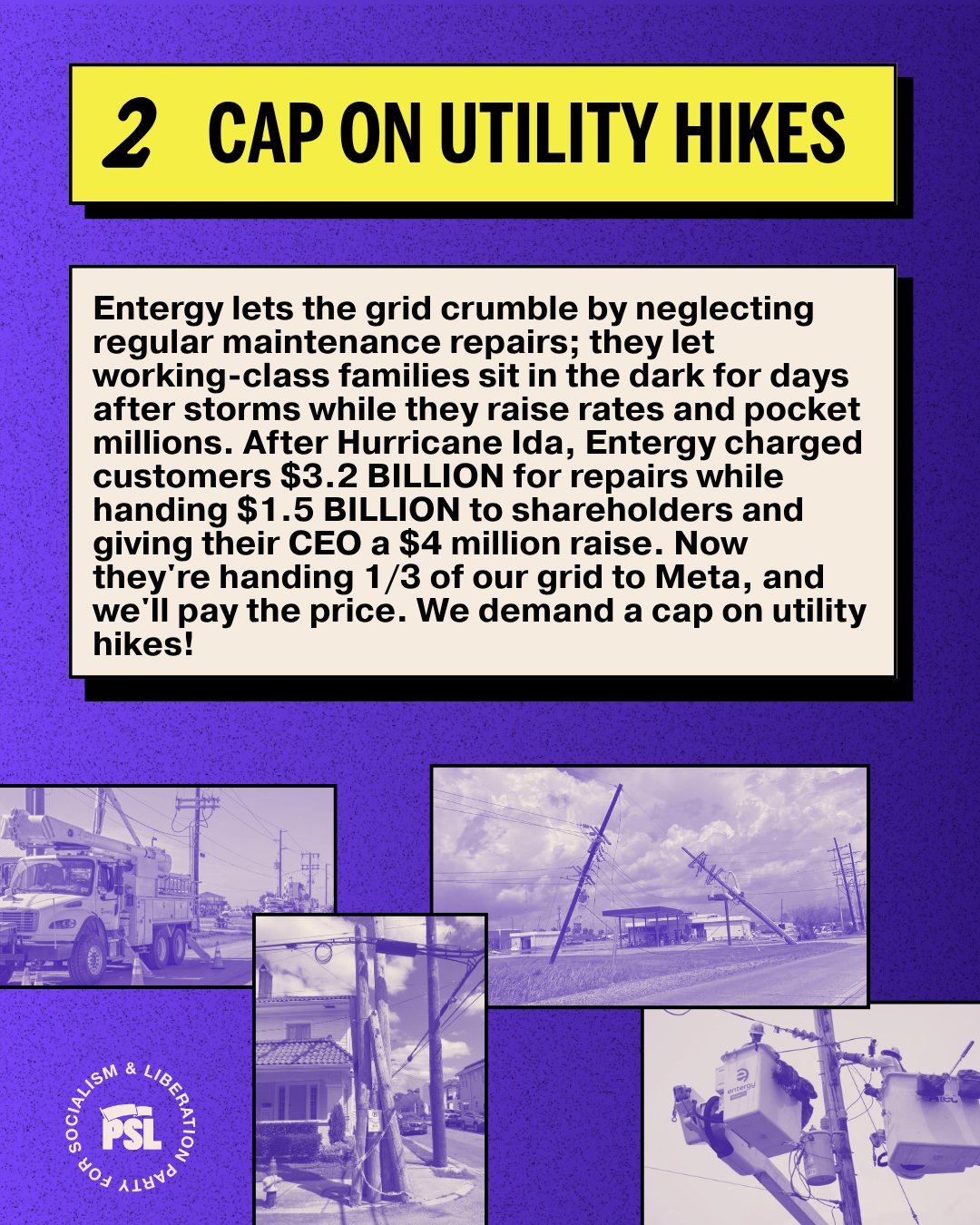
Entergy has neglected the electric grid while raising rates on working families. After Hurricane Ida, customers paid $3.2 billion for repairs as shareholders received $1.5 billion and the CEO got a $4 million raise. We demand a cap on utility rate hikes.
3. Kick Entergy Out of Louisiana Politics
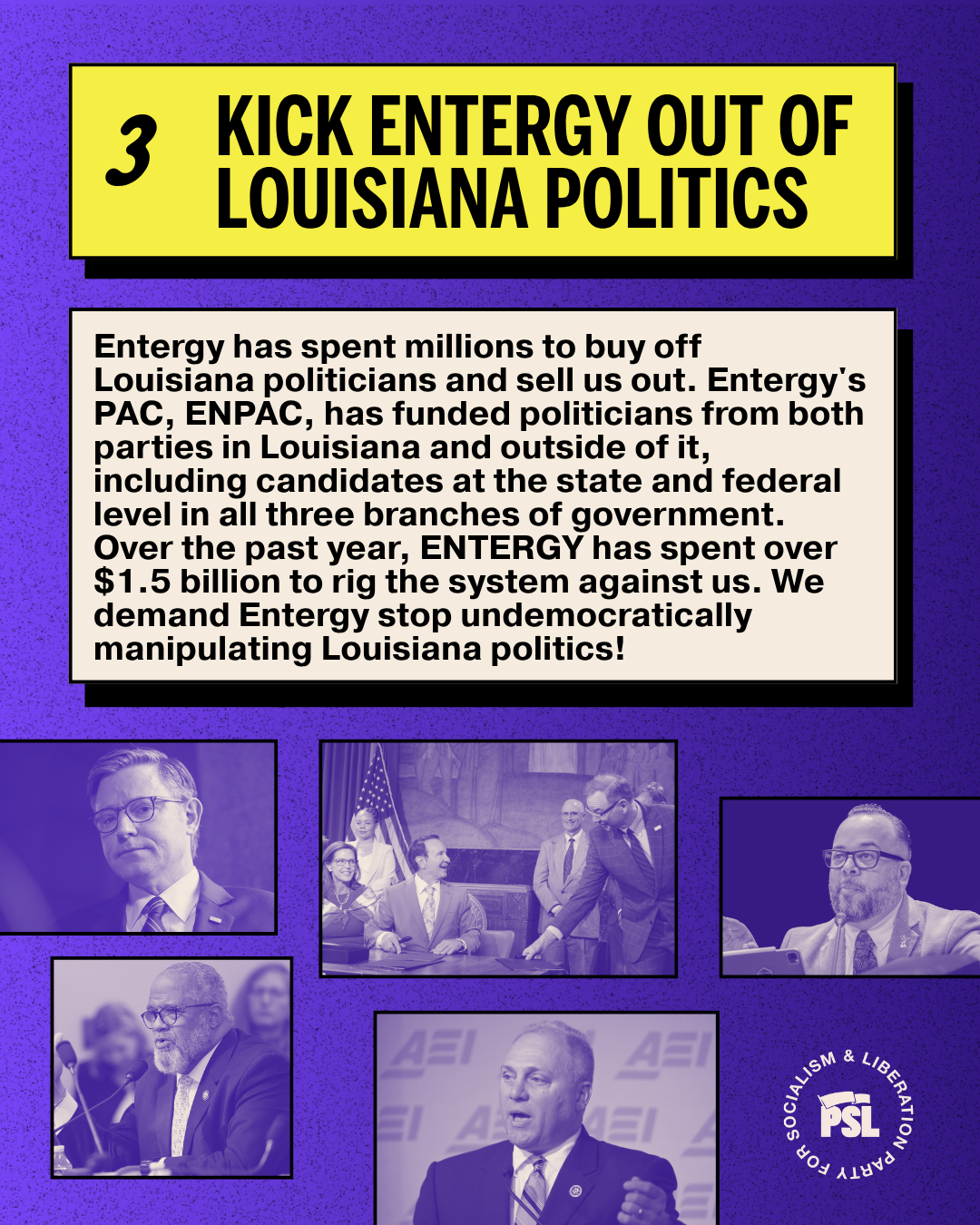
Entergy spends millions to influence Louisiana politics and protect its profits. Its PAC has funded politicians across both major parties and multiple levels of government. We demand Entergy get out of Louisiana politics.
4. Democratic Control Over Utilities
Electricity is a basic necessity, not a commodity. Entergy answers to shareholders like Vanguard and BlackRock instead of the people who rely on its service. We demand a publicly owned utility under democratic control.
The Next Act
These demands are not simply about one company or one data center. They’re about who holds power in our society. Bertolt Brecht understood this nearly a century ago. The ending of The Threepenny Opera is one of the greatest political satires ever written. Mack the Knife—the charming criminal whose life of theft and corruption has finally caught up with him—is led to the gallows. Justice appears ready to prevail.
Then, in one final act of absurdity, a royal messenger arrives.
Mack is pardoned.
He is given a castle.
He is awarded a pension.
He is elevated into the nobility.
The ending is intentionally ridiculous because Brecht wanted his audience to recognize a deeper truth. That in class society, ruling class power protects itself. Those with wealth and influence are rewarded precisely when ordinary people expect accountability.
Brecht was not glorifying crime. He was exposing how exploitation can become respectable once it is wrapped in legal institutions and presented as common sense. A pickpocket steals from one person and can be convicted one year to life. A powerful institution can extract wealth from millions while calling it business.
That is why The Threepenny Opera remains just as relevant today with in light of Entergy's crimes.
Brecht teaches us that theater does not end when the curtain falls. The performance continues in corporate advertising campaigns, regulatory hearings, campaign contributions, and carefully managed public relations events. We are told we are witnessing democracy, competition, and public service. Too often, what we're watching is a performance designed to make exploitation appear inevitable.
But every play has an audience, and every audience has a choice. We can remain spectators while corporations write the script for Louisiana's energy future—or we can take back the power and write the final act.
Sign the Louisiana PSL's "Take Back the Power" petition and join us in building an energy system that serves people—not profit.